
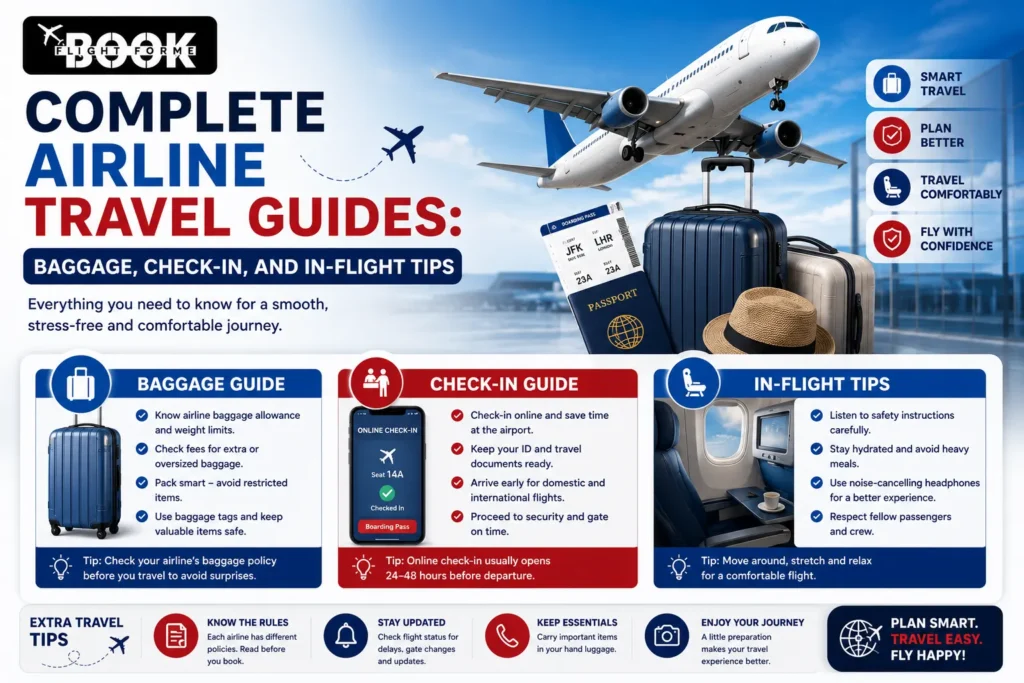
Flying doesn’t have to be stressful. This Airline Travel Guides covers everything you need to know before and during your flight from baggage rules and TSA liquid limits to check-in timelines and in-flight comfort tips so you can travel with confidence and avoid costly surprises at the airport.
Most travel headaches don’t happen at 35,000 feet. They happen before you even board. An overweight bag at the check-in counter. A bottle of shampoo confiscated at security. A missed online check-in window that bumps you to a middle seat. These are the kinds of small, avoidable mistakes that turn an exciting trip into a stressful one.
The good news? Every one of those problems has a simple fix and it starts with knowing the rules before you leave home.
This guide breaks down everything you need to know about Airline Travel Guides: how to pack smart, navigate the airport efficiently, and stay comfortable during your flight. Whether you’re a first-time flyer or a road warrior who just needs a refresher, you’ll find practical, up-to-date information that makes your journey smoother from start to finish.
Baggage Guide: What to Pack, What to Leave Behind, and What It’ll Cost You
What are the carry-on baggage rules and size limits?
Carry-on bags are the bags you bring onto the plane and store in the overhead bin or under the seat in front of you. Most airlines allow one carry-on bag plus one personal item (like a backpack, purse, or laptop bag).
Size limits vary by airline, but a common standard is 22 x 14 x 9 inches (56 x 36 x 23 cm), including handles and wheels. Always check your airline’s specific size policy before packing some budget carriers are stricter than others and may charge fees if your bag doesn’t fit.
General carry-on rules to follow:
- Keep electronics, medications, and valuables in your carry-on not your checked bag
- Avoid overpacking; a stuffed bag may not fit in the overhead bin
- Place your personal item under the seat in front of you to save overhead bin space
What are the checked baggage weight limits?
Checked bags are stored in the cargo hold beneath the plane. Most airlines allow bags up to 50 lbs (23 kg) for standard economy tickets. Bags over 50 lbs are usually charged an overweight fee, and bags over 70 lbs (32 kg) may be refused entirely.
| Bag Type | Typical Weight Limit | Typical Fee (Economy) |
| Carry-on | No weight limit (most US carriers) | Free (usually) |
| 1st Checked Bag | 50 lbs / 23 kg | $30–$40 |
| 2nd Checked Bag | 50 lbs / 23 kg | $40–$65 |
| Overweight Bag (51–70 lbs) | $100–$200 | |
| Oversize Bag (over 62 linear inches) | $100–$200 |
Fees vary by airline and route. Always confirm with your carrier before flying.
What is the TSA 3-1-1 liquids rule?
The TSA 3-1-1 rule applies to liquids, gels, aerosols, creams, and pastes in your carry-on bag. The rule is straightforward:
- 3.4 oz (100ml) or less per container
- 1 quart-sized clear, zip-top plastic bag
- 1 bag per passenger
| Rule Component | Detail |
| Container size | 3.4 oz / 100 ml or smaller |
| Bag type | Clear, quart-sized, zip-top |
| Bags per person | 1 |
| Exceptions | Baby formula, breast milk, medications (notify TSA) |
| Where to place | In bin during X-ray screening |
Anything over 3.4 oz must go in your checked baggage. This includes full-size shampoo bottles, large perfume bottles, and oversized sunscreen containers some of the most commonly confiscated items at security checkpoints.
What can and cannot you pack on a plane?
Knowing what’s restricted can save you a lot of trouble at the security line.
You CAN pack:
- Solid foods (sandwiches, snacks, fruit)
- Prescription medications (with or without original packaging)
- E-readers and laptops (remove from bag at screening)
- Portable chargers (in carry-on only not checked bags)
- Small scissors with blades under 4 inches
You CANNOT pack:
- Flammable liquids or gases
- Firearms or ammunition (without prior airline approval)
- Lithium batteries over 100 watt-hours (in checked bags)
- Gel-based shoe inserts over 3.4 oz (in carry-on)
- Sharp objects like knives or box cutters
When in doubt, check the TSA’s “What Can I Bring?” tool at tsa.gov before you pack.
Check-In Guide: How to Get Through the Airport Without the Stress
What are the best tips for online check-in?
Online check-in usually opens 24–48 hours before departure, depending on your airline. Checking in early online gives you the best chance of selecting a preferred seat especially an aisle or exit row seat.
Top online check-in tips:
- Check in as soon as the window opens for the widest seat selection
- Download your boarding pass to your phone or print a backup copy
- Confirm your bag allowance and add checked bags online (it’s often cheaper than paying at the airport)
- Double-check that your name matches your government-issued ID exactly
How does the airport check-in process work?
If you’re not checking bags, you may be able to go straight to security after checking in online. If you have checked bags, head to the bag drop counter at least 60–90 minutes before domestic flights and 2–3 hours before international flights.
| Check-In Type | Recommended Arrival Time |
| Domestic flight (carry-on only) | 60–90 minutes before departure |
| Domestic flight (checked bags) | 90–120 minutes before departure |
| International flight | 2.5–3 hours before departure |
| Flights with special assistance | 3+ hours before departure |
At the counter, an agent will verify your ID, check your bags, and print or confirm your boarding pass. Bag tags will be attached to your checked luggage before it’s sent to the cargo hold.
What documents and ID do you need to fly?
For domestic US flights, a valid government-issued photo ID is required. Starting May 7, 2025, only REAL ID-compliant IDs will be accepted at TSA checkpoints for domestic travel, per the Department of Homeland Security.
Accepted forms of ID:
- REAL ID-compliant driver’s license or state ID
- U.S. passport or passport card
- DHS-trusted traveler cards (Global Entry, TSA PreCheck, NEXUS)
- Military ID
For international flights, a valid passport is required. Some countries also require a visa check entry requirements well in advance of your trip.
How can you get through airport security screening faster?
Security can be the most unpredictable part of the airport experience. A few habits make it faster:
- Enroll in TSA PreCheck ($85 for 5 years) to skip the standard security line and keep your shoes and laptop in your bag
- Wear slip-on shoes and minimal metal accessories
- Place your quart-sized liquids bag in an easily accessible outer pocket
- Remove laptops and large electronics from your bag before reaching the bin
- Keep your boarding pass and ID in your hand not buried in your bag
In-Flight Tips: How to Stay Healthy, Comfortable, and Sane at 35,000 Feet
What health and wellness tips should you follow on long flights?
Cabin air is drier than most indoor environments, with humidity levels typically below 20%. This leads to dehydration faster than you might expect. Drink water consistently throughout the flight aim for at least 8 oz per hour and limit alcohol and caffeine, which both accelerate dehydration.
Long-haul flights also carry a risk of deep vein thrombosis (DVT), a condition where blood clots form in the legs from prolonged sitting. According to the World Health Organization, the risk roughly doubles on flights over four hours.
Ways to reduce DVT risk:
- Get up and walk the aisle every 1–2 hours
- Do seated calf raises and ankle rolls regularly
- Wear compression socks, especially on flights over 6 hours
- Stay hydrated
What are the best comfort tips for long-haul flights?
Long flights are much more bearable with a little preparation.
Pack a comfort kit in your carry-on:
- Neck pillow (U-shaped memory foam works best)
- Noise-cancelling headphones or quality earplugs
- Eye mask to block cabin light
- Travel blanket or warm layers (cabins can get cold)
- Moisturizer and lip balm for dry cabin air
Seat selection matters. Aisle seats give you easier bathroom access and room to stretch. Window seats are better for sleeping, since you control the shade and can lean against the wall. Avoid seats near lavatories they tend to be noisy and high-traffic.
What should you know about in-flight meals?
If your flight includes a meal service, you’ll usually be asked to select your preference during booking. Many airlines offer special meal options vegetarian, vegan, kosher, halal, gluten-free at no extra charge if requested at least 24–48 hours before departure.
For shorter flights without meal service, pack your own snacks. Good options include:
- Trail mix or nuts
- Protein bars
- Fresh fruit or cut vegetables
- Whole grain crackers
Avoid heavy, greasy foods before and during flights they can worsen bloating caused by cabin pressure changes.
How can you stay entertained and productive on a plane?
Most long-haul flights offer in-seat entertainment, but it’s smart to come prepared.
- Download content in advance: Netflix, Spotify, and most streaming platforms allow offline downloads. Load up before you board.
- Bring a fully charged power bank: Not all seats have USB ports, especially on older aircraft.
- Use the flight for focused work: With fewer distractions and no internet (unless purchased), a long flight can be surprisingly productive for writing, planning, or reading.
- Adjust your watch to your destination time zone as soon as you board to start syncing your sleep schedule.
Quick Reference Tables
Baggage fee overview by airline type
| Airline Type | 1st Checked Bag | 2nd Checked Bag | Carry-on |
| Full-service (e.g., United, Delta) | $30–$40 | $40–$65 | Free |
| Budget (e.g., Spirit, Frontier) | $45–$65 | $55–$75 | $50–$70 |
| International (e.g., Emirates, Lufthansa) | Often included | Varies | Free |
Fees are approximate and subject to change. Check your airline’s website for the most current pricing.
TSA liquid rules at a glance
| Item | Allowed in Carry-on? | Notes |
| Water bottle (full) | ❌ No | Empty bottles are fine; refill after security |
| Travel-size toiletries (≤3.4 oz) | ✅ Yes | Must fit in quart-sized bag |
| Medications | ✅ Yes | Declare at checkpoint if over 3.4 oz |
| Baby formula/breast milk | ✅ Yes | Exempt from 3-1-1 rule |
| Gel shoe inserts | ❌ No (if over 3.4 oz) | Pack in checked bag |
Check-in timeline
| Time Before Flight | What to Do |
| 24–48 hours | Complete online check-in, select seats, add bags |
| 2–3 hours (international) | Arrive at airport, drop bags, go through passport control |
| 90–120 minutes (domestic, checked bags) | Arrive at airport, drop bags, clear security |
| 60–90 minutes (domestic, carry-on only) | Arrive at airport, clear security |
| 30–45 minutes | Be at your gate |
| 10–15 minutes | Boarding typically begins |
Travel Smarter, Every Flight
Good travel doesn’t start on the plane it starts at home, the night before, when you’re packing your bag. The more prepared you are, the more relaxed you’ll be at the airport. And the more relaxed you are, the better your flight will feel.
Use this guide as your pre-flight checklist. Review the baggage rules, prep your liquids bag, check in online as early as you can, and pack a few comfort essentials for the journey. Small efforts before you fly make a genuine difference once you’re in the air.
Safe travels.
Frequently Asked Questions
Can I bring food through TSA security?
Yes. Solid foods are allowed through TSA security in both carry-on and checked bags. Liquids and gels, such as soups, jams, and peanut butter, must follow the 3-1-1 rule if carried on. Large quantities are better packed in checked luggage.
What happens if my bag is overweight at the airport?
If your checked bag exceeds the airline’s weight limit (usually 50 lbs), you’ll be charged an overweight baggage fee, which can range from $100 to $200 depending on the airline. To avoid this, weigh your bag at home before you leave using a luggage scale.
How early should I arrive at the airport for a domestic flight?
For domestic flights with checked baggage, arrive at least 90 to 120 minutes before departure. If you’re traveling with carry-on luggage only, 60 to 90 minutes is usually sufficient. During peak travel periods like holidays, add an extra 30 minutes as a buffer.
Is TSA PreCheck worth it for occasional travelers?
TSA PreCheck costs $85 for a five-year membership, which works out to $17 per year. If you fly two or more times a year, the time savings and reduced stress at security checkpoints make it worthwhile for most travelers.
What should I do if my checked bag is lost or delayed?
Report a lost or delayed bag to your airline’s baggage claim desk immediately after landing before leaving the arrivals area. File a claim in person and request a reference number. Most delayed bags are located and returned within 24–48 hours. Keep receipts for any essential items you buy while waiting, as many airlines offer reimbursement.
Can I bring a portable charger on a plane?
Yes, but only in your carry-on bag. Portable chargers (power banks) containing lithium batteries are prohibited in checked luggage due to fire risk. Most standard power banks (up to 100 watt-hours) are allowed in carry-ons without restriction.
